Christopher Wood Paintings for Sale1901-1930
-
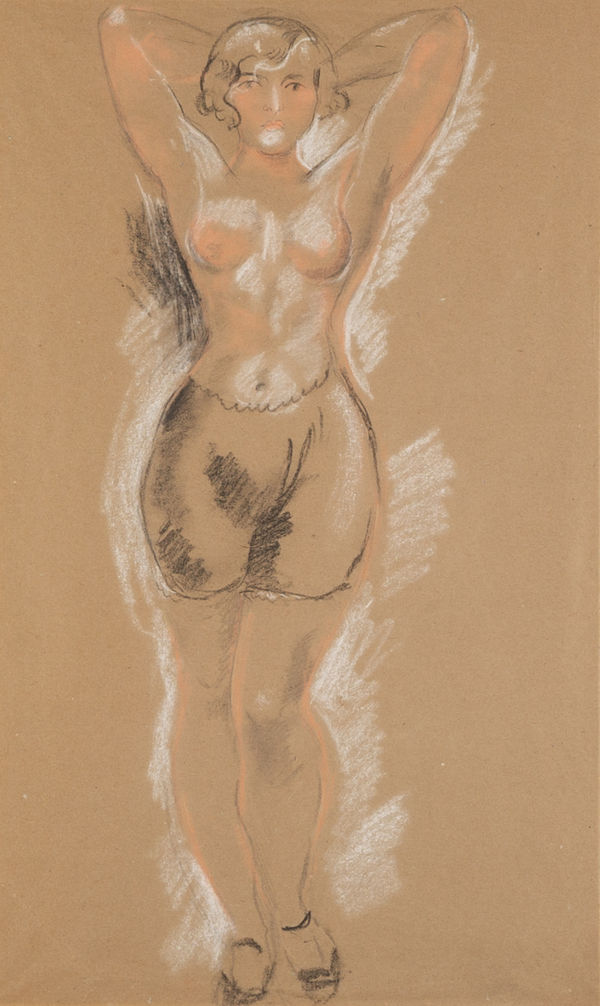
 Christopher WoodNude in Bloomers, 1926£ 5,000.00
 -
Christopher WoodQuay Side (Poole), 1926£ 3,800.00


Christopher Wood was born in Knowsley to Dr Lucius and Clare Wood. He was educated at Marlborough College in Wiltshire, then briefly studied medicine and architecture at Liverpool University before pursuing an artistic career.
At Liverpool University, Wood met Augustus John, who encouraged him to be a painter. The French collector Alphonse Kahn invited him to Paris in 1920, and from 1921 Wood trained as a painter at the Académie Julian, where he met Picasso, Jean Cocteau, Georges Auric and Diaghilev.
By the 1920s, his father was running a General Practice in Broad Chalke, Wiltshire, and Wood painted a series of canvases there, including 'Cottage in Broad Chalke', 'Anemones in a Window, Broad Chalke', and 'The Red Cottage, Broad Chalke'.
In 1926, Wood created designs for 'Romeo and Juliet' by Diaghilev's Ballets Russes, although they were never used. The same year, he became a member of both the London Group and the Seven and Five Society, plus met and befriended Ben and Winifred Nicholson. The Nicholsons' dedication to Wood's work had a significant influence on him, and together they painted in Northumberland and Cornwall, then exhibited at the Beaux Arts Gallery in April-May 1927. Like Nicholson, Wood admired Alfred Wallis, whom Ben and Kit had met on a trip to St Ives, and whose primitivism influenced Wood's own stylistic changes. He claimed that his "mother's people were Cornish and that he got his love of the sea and for boats from his Cornish ancestry".
In April 1929, Wood held a solo exhibition at Tooth's Gallery in Bond Street, London, where he met Lucy Wertheim at the private view. She purchased a picture and soon became one of his biggest supporters. For his part, Wood apparently appreciated the support, telling Mrs Wertheim at her birthday party that:
"I know that my future as a painter from now on will be bound up with your own, and I shall become great through you!"
In May 1930, he had a largely unsuccessful exhibition with Nicholson at the Georges Bernheim Gallery in Paris. In June and July, he made a second sojourn to Brittany to create new work. Later in July, Wertheim travelled to Paris to meet Wood and select the paintings for a one-man show that would open the new Wertheim Gallery in October. While discussing the exhibition over lunch the following day, Wood issued her with an ultimatum: "'I want you to promise to guarantee me twelve hundred pounds a year from the time of my exhibition, one hundred pounds a month being the least I can live on. If I can't have this sum, I've made up my mind to shoot myself'". When she complained, he begged her forgiveness, and they went to review the paintings again.
By 1930, addicted to opium and painting frenetically in preparation for his exhibition, Wood suffered paranoia and began carrying a revolver. On 21 August, he travelled to meet his mother and sister at The County Hotel in Salisbury, for lunch and a discussion on his latest paintings. After saying goodbye, Wood jumped under a moving train at Salisbury railway station. In deference to his mother's wishes, this was reported as an accident.
Christopher Wood is buried in the churchyard of All Saints Church in Broad Chalke, with his gravestone carved by fellow artist Eric Gill.
Although the planned exhibition at the Wertheim Gallery was cancelled on his death, a posthumous exhibition was held elsewhere in February 1931. This was shortly followed by an exhibition at the Lefevre Gallery. The 1938 Venice Biennale included some of his paintings, and later the Redfern Gallery (part of the New Burlington Galleries) compiled a major retrospective.
