Tristram Hillier English, 1905-1983
-
 Tristram HillierBreton Estuary
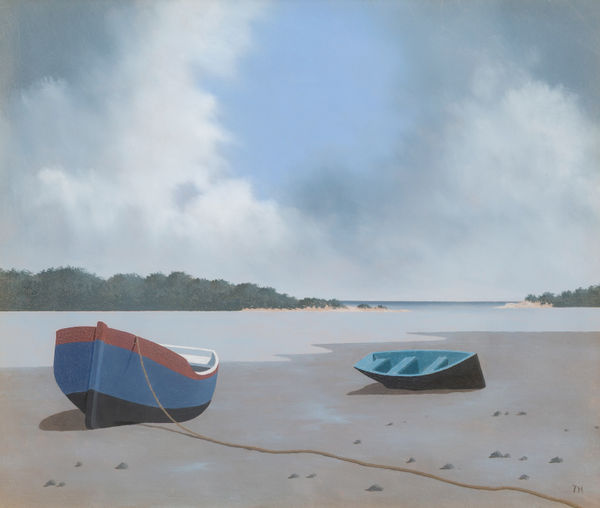

Tristram Paul Hillier RA was an English surrealist painter. He was a member of the influnetial Unit One group.
Hillier was born on 11 April 1905 in Peking (Beijing), China, the youngest of the four children of Edward Guy Hillier, a banker and diplomat, and Ada Everett. A Roman Catholic, he was educated at Downside School. In 1922 he returned to China to study the language, and then until 1924 attended Christ's College, Cambridge. He went to the Slade in 1926, where he studied under Henry Tonks, and then to Paris where he studied for two years under André Lhote, and also at the Atelier Colarossi.
In Paris he met many members of the Surrealist movement; he was particularly influenced by Giorgio de Chirico and Max Ernst. He lived in France until 1940, but travelled extensively; he remained a surrealist painter throughout his life.
His first one-man show was at the Lefevre Gallery in 1931; he later exhibited mainly at Tooth's Gallery. In 1933 Paul Nash formed Unit One, a group of artists including Henry Moore, Barbara Hepworth and Ben Nicholson. Soon after Hillier had graduated from the Slade, and within a year of its formation, he eagerly joined. The artist's work was included in the group’s landmark - in fact only - exhibition, held at the Mayor Gallery and organised by the noted writer and curator Herbert Read.
British Surrealism’s place has often been overlooked in favour of work by the more marketed continental Surrealists, leaving Hillier without a box in which to situate his work. Hillier’s paintings have more in common with the proto-surrealism or metaphysical art of Giorgio de Chirico. Hillier’s paintings hare a similar attention to texture; his surfaces are rendered with pin-sharp precision.
Hillier also had an equal interest in areas of activity that have been absented of human life, lending his towns, harbours, factories and farms an air of futility, perhaps a nod to the increasing disappearance of Britain’s industrial and maritime heritage. However, unlike the theatrically ravaged landscapes of post-war British artists of Paul Nash or Graham Sutherland, Hillier’s landscapes possess an unsettling tranquility – a sense of indeterminable threat bubbling underneath the surface. Hillier’s paintings mostly take landscape as their focus, including reminders of human influence and interaction to draw our attention the eerie stillness of his depictions.
Hiller married twice. From 1931 to 1935 he was married to Irene Rose Hodgkins, the daughter of a bookmaker, with whom he had twin sons, Jonathan and Benjamin. From 1937 he was married to Leda Millicent Hardcastle, daughter of Sydney Hardcastle, the inventor of the First World War Hardcastle torpedo; they had two daughters, Mary and Anna-Clare. During the Second World War he served in the Royal Navy Volunteer Reserve with the Free French. After the war he lived in France and in Spain, and then went to live at East Pennard in Somerset, England.
Hillier's autobiography 'Leda and the Goose' was published in 1954. A retrospective exhibition of his work was held at the Worthing Gallery in 1960. He was made an Associate of the Royal Academy in 1957, and a RA in 1967. A monograph on the artist was published by the Royal Academy in 2008.
